Eisbären Berlin: The History from SC Dynamo to Record DEL Champions
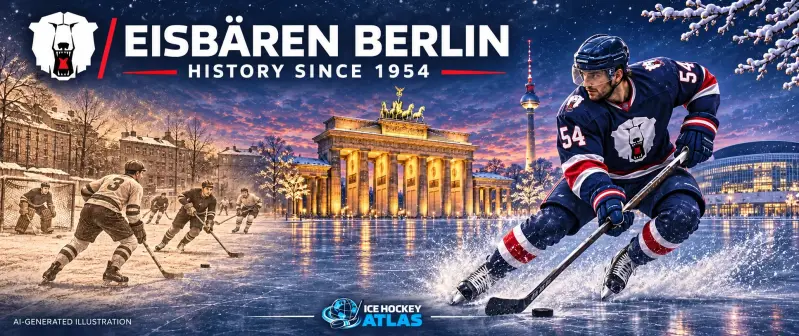
AI-generated illustration celebrating Eisbären Berlin’s history since 1954. Fictional players, historical hockey imagery and Berlin landmarks form an artistic montage; this is not an archival photograph or a geographically accurate scene.
Eisbären Berlin’s history reaches far beyond championship banners. It follows the transformation of a club founded in East Germany’s state sporting system into one of the most successful organisations in modern German ice hockey.
Along the way came the unusual two-team East German league, the uncertainty surrounding reunification, relegation and recovery, a new name, financial restructuring and the development of a distinctive supporter culture.
Two arenas embody that journey. The Wellblechpalast in Hohenschönhausen represents the club’s roots and the closeness between supporters and team. The modern arena beside the East Side Gallery represents its growth into a major professional sporting organisation.
By winning their twelfth DEL championship in 2026, the Eisbären extended their record in the league established in 1994. Their earlier history includes another fifteen championships won as SC Dynamo Berlin in East Germany. These achievements belong to the same club tradition, while remaining titles from two different competition systems
1954: The Beginning as SC Dynamo Berlin
The foundation date recognised in the club’s history is 3 September 1954, when the ice hockey department of SC Dynamo Berlin was established.
Berlin was already a hockey city, but the new department began its own journey within the sporting structures of the German Democratic Republic. Its first season offered an encouraging start: in the 1954/55 DDR-Liga Staffel A, Dynamo won all eight matches and finished with a goal difference of 84–12.
Those results preceded the championship years that would eventually define the club. They also show that the organisation’s development began before it became a leading force in East German hockey.
Building a Team Capable of Challenging Weißwasser
During the following decade, Berlin developed into a serious challenger to the established strength of Weißwasser.
One of the central figures of this generation was Joachim Ziesche, whose importance extended from his playing career into coaching. Another was Hartmut Nickel, who arrived from Weißwasser in 1963.
The latter would become an extraordinary link between different periods of Berlin hockey. As a player, assistant coach, head coach and adviser, Hartmut Nickel helped connect the Dynamo era with the later success of the Eisbären.
1966–1968: The First Championship Dynasty
The breakthrough arrived on 23 January 1966, when SC Dynamo Berlin secured its first East German championship.
Captain and leading scorer Joachim Ziesche was one of the defining players of that achievement. The title came twelve years after the department’s foundation and established Berlin as a championship-winning hockey centre.
Further championships followed in 1967 and 1968, completing the first three-title sequence in the club’s history.
These early successes created a tradition later generations could build upon. Long before the polar bear became the club’s public identity, Berlin had already developed championship experience and players whose influence would continue for decades.
1970: A League Reduced to Two Teams
One of the most unusual chapters in European hockey began when East Germany restricted its elite domestic league to just two teams: SC Dynamo Berlin and SG Dynamo Weißwasser.
The change followed the state’s reassessment of sporting priorities at the end of the 1960s. Ice hockey offered limited prospects for the large numbers of international medals that the East German sporting system sought.
From 1970, the two surviving elite teams repeatedly faced each other for the national championship.
Their competitive lives nevertheless extended beyond those domestic fixtures. International matches provided essential opposition and preparation for the national team. An assessment of the 1970/71 season recorded eight championship games alongside 46 international encounters involving the two clubs.
Calling it simply a two-team league therefore describes the domestic structure, but leaves out an important part of the players’ actual competitive schedule.
Understanding the Dynamo Background
The Dynamo name also requires political context. The club formed part of a sporting structure closely connected to East Germany’s security institutions.
An honest club history must acknowledge that institutional setting alongside the achievements of its athletes. The resources and opportunities available to elite sport existed within an authoritarian political system.
At the same time, the experiences of individual players, coaches and supporters cannot all be reduced to that institutional affiliation. The sporting community that survived the end of East Germany would subsequently build a different identity under radically changed conditions.
The 1970s and 1980s: Fifteen East German Championships
After their first three titles, Berlin enjoyed further sustained periods of domestic success.
SC Dynamo won five consecutive championships from 1976 to 1980, followed by seven consecutive titles from 1982 to 1988. Together with the championships of 1966, 1967 and 1968, this produced a total of fifteen East German league titles.
International competition supplied another measure of the club’s standard. In 1984, Dynamo finished third in the European Cup.
That result matters because it places the club’s achievements beyond the narrow framework of its domestic competition. Berlin’s players were also tested against opposition from other European hockey nations.
The Wellblechpalast: The Emotional Home of Berlin Hockey
The rink in Hohenschönhausen became inseparable from the club’s identity.
Known affectionately as the Wellblechpalast, or “corrugated-metal palace”, it offered a very different experience from a modern entertainment arena. Spectators stood close to the action, and the compact building amplified the noise from the stands.
Its significance grew particularly strong during the difficult years after reunification. Supporting the club there became a shared experience through uncertainty, setbacks and eventual success.
The first three DEL championships were won while the Eisbären still played their home games in Hohenschönhausen. Consequently, the building belongs to both halves of the story: the Dynamo past and the emergence of the modern champions.
For supporters, its importance lies in the memories attached to the place as much as in the structure itself.
1989–1992: Reunification, Relegation and Recovery
The political upheaval of 1989 transformed the conditions under which the club operated.
The state sporting system disappeared. Established arrangements for funding, employment and organisation could no longer be taken for granted. The team needed a future within a different sporting and economic environment.
In 1990, the hockey organisation adopted the name EHC Dynamo Berlin and entered the top division of the reunified German league system.
The first Bundesliga season proved difficult and ended in relegation. Recovery followed quickly, however: promotion in 1992 restored the club to the top flight.
Hartmut Nickel, the first head coach of EHC Dynamo after its admission to the Bundesliga, guided that return. His involvement illustrates the continuity of experience that helped the club survive its most significant institutional upheaval.
1992: The Eisbären Name Creates a New Identity
In 1992, the club became EHC Eisbären Berlin.
The change helped create a more accessible identity for sponsors and supporters in the reunited city. The polar bear provided a recognisable symbol around which the organisation could develop.
A new name did not immediately produce financial security or sporting dominance. The early years of the DEL remained difficult, but the foundations of a competitive team gradually emerged.
A semi-final appearance in 1997 was followed by the club’s first DEL final in 1998, where Berlin finished runner-up to Adler Mannheim.
The takeover by Anschutz Entertainment Group in 1999 became another major turning point, providing the ownership framework associated with the club’s subsequent professional development.
A European Bronze Medal in 1999
On 14 February 1999, Berlin secured third place in the European Hockey League at the final tournament in Moscow.
The team coached by Peter John Lee won the bronze-medal game 4–1.
For a club still navigating the aftermath of reunification and the challenges of professional hockey, this was a substantial international achievement. It also became a lasting shared memory for the supporters who travelled to Russia.
The Early 2000s: Building Towards the Breakthrough
The next stage was to turn a competitive organisation into a champion.
Under Pierre Pagé, Berlin developed a team capable of challenging consistently at the top of the DEL.
The side combined local continuity with experienced international players. Sven Felski embodied the connection with Hohenschönhausen, while Steve Walker became one of the defining attacking figures of the emerging championship era.
Progress included frustration. Berlin reached the semi-finals in 2003 and the final in 2004, but Frankfurt won the latter series.
That defeat left the Eisbären with another near miss. The team had demonstrated its quality; the remaining challenge was to complete a championship run.
2005: The First DEL Championship
On 19 April 2005, the Eisbären finally won their first DEL championship.
Berlin defeated Adler Mannheim 3–0 in the final series, completing the sweep with a 4–1 victory.
The achievement connected several generations of the organisation. Supporters who had experienced relegation and uncertainty could now celebrate a championship in reunited Germany.
The NHL lockout also brought prominent reinforcements to the 2004/05 season, including Olaf Kölzig and Erik Cole.
Alongside them, established figures such as Sven Felski, Steve Walker and Stefan Ustorf helped shape the team’s identity.
The significance of 2005 was therefore both sporting and emotional. A club that had struggled to establish itself in the unified league had reached its summit.
2006: Successful Title Defence
The Eisbären retained the championship in 2006, defeating Düsseldorf 3–0 in the final series.
A second consecutive title demonstrated that the previous year’s success rested on a competitive foundation. Berlin had developed the depth and experience to sustain a championship challenge.
For Pierre Pagé, the back-to-back titles marked the culmination of a highly influential period behind the bench.
2007–2009: A New Coach, a Double and a New Arena
Don Jackson took over as head coach in 2007.
His tenure would become one of the most successful coaching periods in German club hockey, bringing five DEL championships to Berlin.
2008: League and Cup Winners
In 2008, the Eisbären won both the German Cup and the DEL championship.
The league final against Kölner Haie ended 3–1 in Berlin’s favour. Three of the four games required overtime, reflecting how closely the teams were matched despite the final series result.
Goaltender Rob Zepp became an important figure in this championship generation.
The title also marked the end of an era: it was the Eisbären’s final championship before leaving the Wellblechpalast as their regular DEL home. Eisbären Berlin
Moving Beyond Hohenschönhausen
In 2008, the team moved into the new arena beside the East Side Gallery.
The building initially operated as O₂ World, later became Mercedes-Benz Arena and received the name Uber Arena in March 2024.
The move expanded the club’s commercial possibilities and potential audience. It also raised an emotional question familiar to many growing clubs: could the atmosphere associated with a much smaller home survive in a large modern venue?
The Eisbären’s subsequent history would show that the organisation could grow while retaining a strong connection to its earlier home.
2009: Champions in Their New Home
Berlin retained the title in 2009, again defeating Düsseldorf 3–1 in the final series.
The decisive fourth game ended 4–2, after the Eisbären recovered from a two-goal deficit.
Winning immediately after the move helped connect the new arena with sporting success. The championship culture established in Hohenschönhausen had travelled with the team.
2011–2013: Three Consecutive DEL Championships
2011: A Final Sweep Against Wolfsburg
In 2011, the Eisbären defeated Wolfsburg 3–0 in the final series.
It was the club’s fifth DEL championship and the beginning of a run of three consecutive titles.
By this stage, Berlin’s experience in decisive series had become a significant part of its competitive identity.
2012: The Extraordinary Comeback Against Mannheim
The 2012 final against Adler Mannheim produced one of the most dramatic chapters in Eisbären history.
Berlin trailed the series 2–1 and faced elimination in the fourth game. With Mannheim leading 5–2, the championship appeared close to being decided.
The Eisbären recovered to win 6–5 in overtime, forcing a fifth game. Berlin then won the decider 3–1 to retain the title.
The comeback illustrates why individual matches can become central to a club’s collective memory. The eventual championship depended on recovering from a position in which the season was close to ending.
2013: Completing the Triple
In 2013, Berlin defeated Kölner Haie 3–1 in the final series, winning the decisive game 4–1.
The victory completed three consecutive championships and brought the club’s DEL total to seven.
Players including André Rankel, Frank Hördler and Rob Zepp became closely associated with this era.
For Don Jackson, it was the fifth Berlin championship, following the titles of 2008, 2009, 2011 and 2012.
2014–2020: The Difficult Years Between Championship Eras
After 2013, the Eisbären experienced a prolonged period without another championship.
The team continued to compete, but the automatic expectation of another title no longer matched its results.
The closest opportunity came in 2018, when Berlin reached the final against Munich. That series went the full seven games, with the Eisbären finishing runner-up after a 4–3 series defeat.
Serge Aubin became head coach in 2019, beginning the next major coaching era.
The following season ended under exceptional circumstances. The 2020 playoffs were cancelled because of the coronavirus pandemic, leaving the championship undecided.
2021: Champions Again Under Exceptional Conditions
The 2020/21 season brought a competition shaped by pandemic restrictions and unusually short playoff series.
Berlin faced elimination repeatedly. In each of their three best-of-three series, the Eisbären lost the opening game before winning the next two.
The final against Wolfsburg followed the same pattern. Berlin recovered from a 1–0 series deficit and won the decisive game 2–1.
Leonhard Pföderl scored the championship-winning goal.
After eight years without a title, the Eisbären were champions again. The circumstances differed sharply from the crowded celebrations of earlier seasons, but the sporting achievement began a new period of success under Serge Aubin.
2022: A Ninth DEL Championship
Berlin defended the championship in 2022, defeating Munich 3–1 in the best-of-five final.
The decisive fourth game ended 5–0.
Defenceman Frank Hördler received the award as the final series’ most valuable player. He had been part of all nine Eisbären DEL championship teams up to that point.
That achievement gave the season a particular historical dimension. One player connected the first triumph in 2005 with the championship-winning side of 2022.
Meanwhile, forwards including Marcel Noebels and Leonhard Pföderl represented the attacking strength of the newer generation.
2023: A Sharp Setback
The season after the successful title defence brought a dramatic reversal.
Berlin finished eleventh in the 2022/23 regular season, missing the playoffs.
For the reigning champions, this was a substantial disappointment. It also provides necessary context for what followed: the next championship did not emerge from uninterrupted dominance.
The club had to recover from a season in which it had fallen well below its own expectations
2024: Returning to the Top Against Bremerhaven
The response came in 2024.
Berlin faced the Fischtown Pinguins Bremerhaven in the final and lost the opening game. The Eisbären then won four consecutive matches to take the series 4–1.
A 2–0 victory in the fifth game secured the championship.
Leonhard Pföderl was named the final series’ most valuable player.
The tenth DEL title was therefore also a recovery story: within one year, Berlin had moved from missing the playoffs to winning the championship.
2025: Grief and an Eleventh Championship
The 2024/25 season included a loss far more significant than any sporting result.
On 29 January 2025, Tobias Eder died at the age of 26 following a serious illness.
He had joined Berlin in 2023 and been part of the championship-winning team in 2024.
His death affected teammates, staff, supporters and the wider hockey community. Remembering him belongs within the club’s history in its own right, beyond the results of that season.
A Remarkable Final Against Cologne
In the 2025 final, Berlin defeated Kölner Haie 4–1 in the series.
The final three matches each ended 7–0, an extraordinary sequence at the decisive stage of the competition.
Ty Ronning received the final series MVP award.
The championship increased Berlin’s DEL total to eleven and confirmed the strength of the team assembled during this period.
2026: Twelve DEL Titles and a Second Triple
On 3 May 2026, the Eisbären secured another championship by defeating Adler Mannheim 4–1 away from home.
The same scoreline, 4–1, decided the overall final series.
Ty Ronning scored twice in the deciding match, while goaltender Jonas Stettmer was named the final series’ most valuable player.
The achievement gave Berlin its twelfth DEL championship and completed a second run of three consecutive titles:
2011, 2012 and 2013.
2024, 2025 and 2026.
Berlin became the first DEL club to achieve two such championship triples. Including the fifteen East German titles won by SC Dynamo, the organisation’s tradition now encompassed 27 national league championships across the two systems.
A Coaching Transition After the Championship
The 2026 championship was the fifth Berlin title under Serge Aubin, following those of 2021, 2022, 2024 and 2025.
His departure brought another major coaching era to an end.
In June 2026, the club announced Éric Dubois as its new head coach for the 2026/27 season.
The appointment opened the next chapter for an organisation whose history repeatedly combines continuity with changes in leadership.
The People Who Connect the Different Eras
Championship lists record when a team won. Individual careers help explain how a club’s culture travels between generations.
A Lifetime of Service
Hartmut Nickel remains one of the clearest examples.
Arriving in Berlin in 1963, he contributed as a player and in several coaching and advisory roles. Apart from three years in Hannover, his career remained closely connected to the organisation.
His retirement ceremony in 2016 recognised 53 years of service associated with the club. His name under the arena roof commemorates a contribution spanning the Dynamo years, reunification and the first modern championship dynasty.
A Defining Figure of the Championship Generation
Steve Walker became one of the leading figures of Berlin’s first DEL championship era.
His number 27 was retired, placing his contribution among the achievements the organisation chose to preserve permanently.
Such recognition reflects more than statistics. It acknowledges the importance of a player within a period when Berlin established itself as a championship club.
Continuity on the Ice
The careers of Sven Felski and Frank Hördler likewise help explain why different Eisbären teams feel connected.
Their long association with Berlin gave supporters familiar figures through changing squads, coaches and competitive circumstances.
In a professional sport shaped by transfers, these extended relationships become an important part of a club’s identity.
Supporters, Memory and the Meaning of the Club
The Eisbären’s identity developed through the interaction of sporting success and shared experience.
Supporters who followed the organisation through the uncertainty of the 1990s experienced a very different club from those who first encountered it as a regular championship contender.
Both experiences now belong to the same community. The Wellblechpalast remains a point of reference, while the larger arena has introduced the team to a wider audience.
The history also resists a simple division between an old East German club and a completely separate modern organisation. Players, staff, supporters and memories crossed that political and sporting transition.
The result is a club whose significance extends beyond the number of championships: its history preserves something of Berlin’s own upheavals, adaptations and changing sense of identity.
Eisbären Berlin: Major Titles and Honours
DEL championships — 12:
2005, 2006, 2008, 2009, 2011, 2012, 2013, 2021, 2022, 2024, 2025 and 2026.
East German championships as SC Dynamo Berlin — 15:
1966, 1967, 1968, 1976, 1977, 1978, 1979, 1980, 1982, 1983, 1984, 1985, 1986, 1987 and 1988.
German Cup:
2008.
European Trophy:
2010.
East German federation cup — DELV-Pokal:
1963, 1964, 1965, 1973 and 1988.
European Cup:
Third place in 1984.
European Hockey League:
Third place in 1999.
Continental Cup:
Second place in 1998 and 2000.
Spengler Cup:
Third place in 2005.
The twelve DEL titles establish Berlin’s championship record within the DEL era, which began in 1994. The fifteen East German championships remain a separate part of the organisation’s historical honours.
Explore Eisbären Berlin with Ice Hockey Atlas
Discover the club’s contact details, official channels and arena information on the Eisbären Berlin club profile.
Planning a matchday in the German capital? Explore our Eisbären Berlin visitor guide for tickets, travel information and advice for visiting the arena.