Chicago Blackhawks History: From 1926 to Six Stanley Cups and a New Era
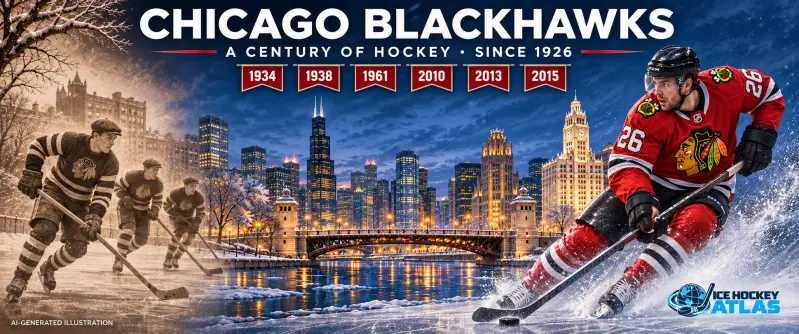
A century of Chicago Blackhawks hockey: a fictional historical-to-modern composition with the Chicago skyline and the six Stanley Cup championship years. AI-generated illustration; not an archival photograph or a depiction of specific players.
The history of the Chicago Blackhawks stretches from the crowded ice of the Chicago Coliseum to championship nights at the United Center. Founded in 1926, the franchise became one of the NHL’s Original Six, won six Stanley Cups and helped make Chicago one of North America’s great hockey cities. Its story includes revolutionary scorers, remarkable goaltenders, long periods of frustration and a modern championship team that reshaped the league.
It is also a history that deserves more than a collection of highlights. The Blackhawks’ identity was built by generations of supporters, changes in ownership, the atmosphere of two famous arenas and difficult questions about the organisation’s responsibilities. Understanding the club means looking at both its achievements and its failures.
1926–1929: How NHL Hockey Came to Chicago
Frederic McLaughlin and a New NHL Franchise
The NHL approved Chicago’s franchise on 25 September 1926. Its first owner, Frederic McLaughlin, was a Chicago businessman and former military officer. The new organisation acquired players from the Portland Rosebuds after the collapse of the western professional league, giving Chicago an experienced foundation for its first NHL season. This was the creation of a new NHL franchise, rather than the relocation of an existing NHL team.
The team played its first game on 17 November 1926 at the Chicago Coliseum, defeating the Toronto St. Patricks 4–1. That opening victory began a relationship between the city and professional hockey that would outlast economic crises, changes in the sport and decades between championships.
Where the Blackhawks Name Came From
McLaughlin had served in the US Army’s 86th Infantry Division, associated with the “Blackhawk” name. The team’s name followed that military connection, whose historical reference ultimately reaches back to the Sauk leader Black Hawk. For much of the franchise’s history, its name appeared as two words: Chicago Black Hawks. The official spelling became Chicago Blackhawks in 1986.
Chicago is an Original Six club, but that does not mean it founded the NHL in 1917. The term describes the six teams that comprised the league from 1942 until expansion in 1967: Boston, Chicago, Detroit, Montreal, New York and Toronto. Chicago entered the NHL nine years after the league was established.
1929–1938: Chicago Stadium and the First Stanley Cups
The Madhouse on Madison
In 1929, the Blackhawks moved into Chicago Stadium. The building became inseparable from the club’s identity: steep seating, organ music and a crowd whose noise seemed to gather underneath the roof. Its reputation as the “Madhouse on Madison” reflected the intensity of the experience as much as the hockey played there.
The stadium gave the franchise a permanent stage. For supporters, a Blackhawks game became a recognisable Chicago ritual. For visiting teams, it could be an intimidating environment. Decades later, even after its replacement, the old building remained a reference point for what Blackhawks hockey was supposed to feel like.
1934: The First Stanley Cup
Chicago reached its first Stanley Cup Final in 1931, losing to Montreal. Three years later, the Blackhawks returned with a team anchored by captain and goaltender Charlie “Chuck” Gardiner. His importance went beyond making saves: he gave the team stability during a period when goaltending could determine an entire playoff run.
On 10 April 1934, Mush March scored in double overtime to give Chicago a 1–0 victory over Detroit and its first Stanley Cup. The Blackhawks won the best-of-five Final three games to one. For a franchise still less than eight years old, the championship established that Chicago could compete with the sport’s strongest organisations.
The triumph was followed by tragedy. Chuck Gardiner died on 13 June 1934, aged 29. His death, only weeks after captaining the champions, gives the first Cup a particularly poignant place in Blackhawks history. The celebration and the loss remain closely linked in the story of that team.
1938: An Unlikely Champion
The second championship was much less predictable. Chicago finished the 1937–38 regular season with a 14–25–9 record, yet survived the playoffs and reached the Final against Toronto. It remains a reminder that the regular season and the Stanley Cup tournament can produce very different stories.
An injury to goaltender Mike Karakas created an extraordinary complication. Emergency replacement Alfie Moore helped Chicago win the opening game of the Final, before Mike Karakas returned later in the series. The Blackhawks defeated Toronto three games to one, securing the Cup with a 4–1 victory in Game 4 on 12 April 1938.
Chicago’s first two titles therefore came through contrasting routes: the authority of a great captain-goaltender in 1934 and an improbable playoff transformation in 1938. Both became part of the club’s mythology, but neither led to a sustained run of championships.
The 1940s and 1950s: Great Individual Talent, Difficult Team Years
The Bentley Brothers and the Pony Line
The Blackhawks produced entertaining attacking hockey even when the team could not consistently challenge for the Cup. Max Bentley, Doug Bentley and Bill Mosienko formed the celebrated “Pony Line”, a combination associated with speed, skill and smaller forwards who could trouble larger opponents.
Their importance was stylistic as well as statistical. They showed how quickly the puck could move when anticipation and skating worked together. Chicago reached the 1944 Stanley Cup Final, but Montreal swept the series. The appearance was significant; the inability to turn it into a championship was equally characteristic of the wider era.
Their importance was stylistic as well as statistical. They showed how quickly the puck could move when anticipation and skating worked together. Chicago reached the 1944 Stanley Cup Final, but Montreal swept the series. The appearance was significant; the inability to turn it into a championship was equally characteristic of the wider era.
Bill Mosienko’s 21-Second Hat Trick
On 23 March 1952, Bill Mosienko scored three goals in 21 seconds against the New York Rangers. The achievement became one of hockey’s most famous scoring records. Three goals in a single game can define an excellent evening; three in less than half a minute occupies a different category altogether.
That moment also illustrates the contrast running through this period. Chicago could have exceptional players and unforgettable individual performances without possessing the depth required to dominate the league. The club needed a stronger foundation, especially across defence and in goal, before it could become a champion again.
The Rebuild That Led to 1961
The emergence of Bobby Hull and Stan Mikita changed Chicago’s attacking possibilities. Bobby Hull brought explosive skating and a devastating shot; Stan Mikita supplied creativity, intelligence and a capacity to control the flow of a game. They became two of the defining figures in franchise history, but the team’s revival was not solely an offensive story.
Glenn Hall gave Chicago elite goaltending, while Pierre Pilote provided leadership and exceptional defensive play. Together, these players supplied the balance the club had lacked. Goals could win individual nights; reliable goaltending and a strong defensive structure made a long playoff run possible.
1961: Ending a 23-Year Wait
In 1961, Chicago defeated Montreal in the semifinals, ending the Canadiens’ attempt to extend a run of five consecutive Stanley Cups. The Blackhawks then faced Detroit in the Final. On 16 April, a 5–1 victory in Game 6 completed a four-games-to-two series win and delivered Chicago’s third championship.
The title ended a wait stretching back to 1938. It also validated a team built around complementary strengths rather than a single star. Bobby Hull and Stan Mikita became enduring symbols of the triumph, but Glenn Hall and Pierre Pilote were central to its foundation.
For supporters, 1961 became a reference point that would grow more powerful with time. At the moment of victory, nobody knew that the next championship would be almost half a century away.
The 1960s and 1970s: Superstar Hockey Without Another Cup
Bobby Hull and Stan Mikita Redefine the Franchise
Bobby Hull scored 604 regular-season goals for Chicago. His power and speed made him one of the sport’s most recognisable players, and his departure for the World Hockey Association’s Winnipeg Jets in 1972 was a major turning point. It demonstrated that even an established NHL club could lose a defining attraction to a rival league.
Stan Mikita spent his entire NHL playing career with Chicago. Across 22 seasons, he accumulated 1,467 points in 1,394 regular-season games, including 926 assists. His four scoring titles and two Hart Trophies reflected his standing among the league’s best. In both 1967 and 1968, he combined the Art Ross, Hart and Lady Byng trophies, an extraordinary blend of production, value and sportsmanship.
Their careers gave Chicago a permanent place in discussions of hockey’s greatest players. Yet their presence could not guarantee repeated championships. The Blackhawks reached the Final in 1962 and 1965, losing to Toronto and Montreal respectively.
Tony Esposito and the Near Misses of 1971 and 1973
Tony Esposito arrived from Montreal in 1969 and immediately transformed Chicago’s goaltending. His 15 shutouts in 1969–70 helped earn him both the Calder Trophy and the Vezina Trophy. He would finish his Blackhawks career with 418 regular-season victories and 74 shutouts.
The 1971 Final produced one of the most painful defeats in franchise history. Chicago led Montreal 2–0 in Game 7 but lost 3–2. A championship had been within reach, making the reversal difficult to separate from memories of the period. In 1973, the Blackhawks returned to the Final and again lost to Montreal, this time in six games.
The lesson was uncomfortable: a team could be consistently strong, employ outstanding players and still finish short. Chicago remained relevant, but the distance between relevance and a Stanley Cup continued to define the decades after 1961.
The 1980s and Early 1990s: Skill, Toughness and Another Final
Denis Savard and a New Generation
Selected in the 1980 draft, Denis Savard became the centrepiece of a new attacking era. His creativity and famous spin-o-rama gave Chicago a player capable of changing a game with a single movement. His 131-point season in 1987–88 remains one of the great offensive campaigns in club history.
Steve Larmer brought scoring and dependability, winning the Calder Trophy in 1983. On defence, Doug Wilson combined offensive production with a heavy shot; his 39 goals and 85 points in 1981–82 helped earn him the Norris Trophy. These were teams with genuine quality, even as the championship drought lengthened.
From 1969 through 1997, Chicago qualified for the playoffs in 28 consecutive seasons. That streak speaks to sustained competitiveness, although qualification alone did not mean the club was equally close to winning every year. The defining frustration remained the same: regular postseason appearances without a Cup.
Chris Chelios, Ed Belfour and the 1992 Run
The 1990 trade that brought Chris Chelios from Montreal sent Denis Savard in the other direction. Chicago gained a defenceman whose competitiveness, mobility and physical edge would shape the team throughout the decade. Ed Belfour emerged as an elite goaltender, winning the Calder and Vezina trophies in 1991, while Jeremy Roenick added an aggressive attacking presence.
In 1992, the Blackhawks reached their first Stanley Cup Final since 1973. Pittsburgh won all four games. The sweep was a harsh ending to a memorable run, and Chicago’s next opportunity to win the championship would not arrive for another 18 years.
1994–2007: A New Arena and a Difficult Transition
From Chicago Stadium to the United Center
The United Center opened in August 1994, replacing Chicago Stadium as the Blackhawks’ home. The move brought a larger modern venue, expanded facilities and a new commercial setting for the franchise. The old stadium was demolished in 1995, ending a physical connection to more than six decades of club history.
For many fans, the transition involved more than changing seats. Chicago Stadium had developed its character over generations. The United Center needed its own defining hockey moments, and those would take time to arrive. It eventually became a championship venue, but its early Blackhawks years were much less successful.
Losing Momentum
By the late 1990s and early 2000s, Chicago’s standing had declined. Playoff appearances became scarce, attendance suffered and the club struggled to connect with a new generation of supporters. The longstanding policy restricting local television coverage of home games further limited visibility at a time when other sports organisations were expanding their reach.
The period matters because it makes the later revival easier to understand. Chicago was not simply waiting for one more superstar. It needed better decisions on the ice and a more open relationship with its audience. The recovery would involve broadcasting, community engagement and organisational direction as well as drafting.
2007–2009: Building the Modern Blackhawks
A New Relationship With Chicago
After Bill Wirtz’s death in 2007, Rocky Wirtz assumed leadership and helped change the franchise’s public approach. Selected home games returned to local television in 2007, followed by a full television schedule for 2008–09. That change made the team easier to follow and helped reconnect the Blackhawks with the city.
The sporting foundation had already begun to take shape through the draft. Duncan Keith arrived through the 2002 draft, Brent Seabrook through 2003, Jonathan Toews through 2006 and Patrick Kane as the first overall selection in 2007. Those selections would form the spine of the modern championship teams.
Joel Quenneville and the Step Towards Contention
Joel Quenneville became head coach in 2008. The young team combined ambition with increasingly clear expectations: responsible play, demanding matchups and the ability to use exceptional skill within a coherent structure. Jonathan Toews brought an all-round presence at centre, while Patrick Kane supplied elite creativity and puck control.
Chicago reached the Western Conference Final in 2009 before losing to Detroit. The defeat exposed the distance still to travel, but it also showed that the rebuilding years had produced a contender. The Blackhawks were no longer an organisation trying to become visible again; they were becoming a team opponents had to plan around.
2010: The Stanley Cup Returns After 49 Years
A Team With More Than Two Stars
The 2009–10 Blackhawks had depth behind their headline forwards. Marian Hossa and Patrick Sharp added high-end attacking quality, Duncan Keith and Brent Seabrook anchored the defence, and Antti Niemi supplied the goaltending during the championship run. Jonathan Toews and Patrick Kane were central, but the team’s strength came from the number of ways it could win.
Chicago advanced to the Final against Philadelphia. Jonathan Toews recorded 29 points during the playoffs and won the Conn Smythe Trophy. The series combined speed, pressure and unpredictable swings, eventually reaching Game 6 in Philadelphia with Chicago one victory from the title.
Patrick Kane’s Overtime Winner
On 9 June 2010, Patrick Kane scored in overtime to give Chicago a 4–3 victory and a four-games-to-two series win. The puck’s path initially left some people uncertain whether it had crossed the line. The celebration began before the entire arena understood what had happened, producing one of the most distinctive endings to a Stanley Cup Final.
The championship ended a 49-year drought. For older supporters, it connected the present to 1961; for younger ones, it created their first experience of a Blackhawks Cup. The victory also gave the United Center era the defining achievement it had previously lacked.
Salary-cap pressure quickly forced changes to the roster. That made the next challenge particularly difficult: Chicago had to remain competitive while replacing valuable supporting players. The championship core stayed together, but another title would require adaptation.
2013: A Remarkable Season and 17 Unforgettable Seconds
Dominating a Shortened Regular Season
The lockout-shortened 2012–13 season lasted 48 games. Chicago opened with points in 24 consecutive games, going 21–0–3 during that stretch, and finished 36–7–5. The Presidents’ Trophy recognised a regular season in which the Blackhawks set the standard across the league.
The playoffs demanded a different kind of excellence. A brilliant regular-season record offered no protection against elimination, and Chicago needed resilience as well as skill. By the Final against Boston, the team had shown it could handle both sustained pressure and narrow margins.
Boston, Game 6 and a Championship Turnaround
On 24 June 2013, Chicago trailed Boston 2–1 late in Game 6. Bryan Bickell equalised at 18:44 of the third period. Dave Bolland scored at 19:01. In 17 seconds, a game apparently heading towards a Boston victory became a 3–2 Chicago win and a championship-clinching moment.
Patrick Kane won the Conn Smythe Trophy, while Corey Crawford had established himself as the team’s championship goaltender. The Blackhawks had won their second Cup in four seasons, this time through an ending that became shorthand for the unpredictability and drama of playoff hockey.
2015: Three Stanley Cups in Six Seasons
Duncan Keith’s Defining Playoffs
Chicago lost a seven-game Western Conference Final to Los Angeles in 2014, then returned to the championship stage in 2015. Duncan Keith was central to that run, combining enormous responsibility with effective play at both ends of the ice. His 21 playoff points accompanied the defensive work and heavy workload that made him indispensable.
Against Tampa Bay in the Final, Chicago again showed that it could operate within tight games. The team did not need every night to become a scoring contest. Experience, defensive judgement and timely goals were now as important to its identity as its attacking talent.
Winning the Cup at Home
On 15 June 2015, a 2–0 victory in Game 6 secured the series four games to two. Corey Crawford recorded the shutout, and Duncan Keith received the Conn Smythe Trophy. For the first time since 1938, Chicago clinched a Stanley Cup on home ice.
Three championships in six seasons established the 2010–15 Blackhawks as one of the salary-cap era’s defining teams. Jonathan Toews, Patrick Kane, Duncan Keith, Brent Seabrook, Marian Hossa, Patrick Sharp and Corey Crawford formed a core whose shared history became an advantage in demanding situations. Their success was sustained, rather than the product of a single exceptional spring.
After 2015: The End of a Championship Cycle
Championship teams do not remain intact indefinitely. Contracts become more expensive, injuries accumulate and successful supporting players become difficult to retain. Chicago continued to chase contention, but the balance that had produced three Cups became harder to maintain.
First-round defeats followed in 2016 and 2017, including a sweep by Nashville in 2017. The Blackhawks missed the playoffs in 2018. Their appearance in the expanded 2020 postseason brought a qualifying-round victory over Edmonton before elimination against Vegas, but it did not signal a return to the level of the championship years.
The gradual departure of the core turned sporting decline into a broader change of identity. By 2023, Patrick Kane had been traded to the New York Rangers and Jonathan Toews had played his final game for Chicago. The shared era that had defined the franchise for so many supporters had reached its conclusion.
Kyle Beach and the Organisation’s Failure of Responsibility
A complete history must also address the failure to respond properly to the allegations raised by Kyle Beach in 2010. An independent investigation published in October 2021 examined the organisation’s handling of his report of sexual assault by a then-video coach. It documented a serious failure of leadership and a delay in taking action.Klicke hier, um einen Text zu schreiben.
The report described a leadership discussion on 23 May 2010 and the later notification of human resources after the championship run. The NHL fined the franchise $2 million, and the Blackhawks reached a settlement with Kyle Beach in December 2021. These events are a necessary part of the historical record, not an optional footnote to the Cup celebrations.
The sporting achievements of 2010 can be recorded accurately while also recognising the harm caused by the organisation’s response. Championships do not remove an employer’s responsibility to protect people. Any assessment of the modern Blackhawks must keep that distinction clear.
Connor Bedard and the Next Chapter
Chicago selected Connor Bedard first overall in the 2023 NHL Draft. His arrival gave the rebuild a new focal point, and his Calder Trophy in 2024 provided an early individual milestone. Expectations were immediate, but the history of the franchise offers a useful caution: exceptional talent and a complete championship team are different things.
The successful rebuild of the 2000s depended on several drafts, defensive development, supporting players and organisational change. A new era likewise requires more than one scorer. The lasting question is how Chicago builds the depth, stability and collective identity needed to turn promise into sustained success.
The franchise reached its centenary in 2026. Looking back over those hundred years reveals no uninterrupted rise. Chicago’s story moves between breakthroughs and long waits, celebrated players and difficult transitions. That complexity is what gives its history substance.
Chicago Blackhawks Honours and Records
All Six Stanley Cup Championships
1934 — Defeated the Detroit Red Wings, 3–1 in the Final.
1938 — Defeated the Toronto Maple Leafs, 3–1 in the Final.
1961 — Defeated the Detroit Red Wings, 4–2 in the Final.
2010 — Defeated the Philadelphia Flyers, 4–2 in the Final.
2013 — Defeated the Boston Bruins, 4–2 in the Final.
2015 — Defeated the Tampa Bay Lightning, 4–2 in the Final.
Selected Franchise Milestones
Founded — 1926.
First NHL game — 17 November 1926; a 4–1 win against the Toronto St. Patricks.
Original Six era — 1942–1967.
Chicago Stadium home era — 1929–1994.
United Center opened — August 1994.
Consecutive playoff qualifications — 28 seasons, from 1969 through 1997.
Longest wait between Stanley Cups — 49 years, from 1961 to 2010.
Modern championship period — Three Stanley Cups in six seasons: 2010, 2013 and 2015.
Selected Historic Player Records
Stan Mikita — 1,467 regular-season points and 926 assists for Chicago.
Bobby Hull — 604 regular-season goals for Chicago.
Tony Esposito — 418 regular-season wins and 74 shutouts for Chicago.
Bill Mosienko — Three goals in 21 seconds against the New York Rangers on 23 March 1952.
These figures refer to the stated player achievements and do not attempt to reproduce every current franchise leaderboard.
Explore the Blackhawks With Ice Hockey Atlas
Explore our Chicago Blackhawks club profile for club and arena information. To plan a trip, read our Chicago Blackhawks visitor guide, covering an NHL weekend, the city skyline and the United Center.
Sources and Further Reading
This history draws on NHL Stanley Cup records, the Blackhawks’ season-by-season record, official 1938 championship records, 1961 championship records, 2010 championship records and 2013 championship records. Arena history is documented by the United Center and the Encyclopedia of Chicago. The discussion of the organisation’s handling of the 2010 allegations is based on the independent investigation published by Jenner & Block and WBEZ’s reporting on the settlement. Player names link directly to their Eliteprospects profiles.
Historical overview prepared on 25 November 2026. The account focuses on established franchise history rather than daily results or a live roster.