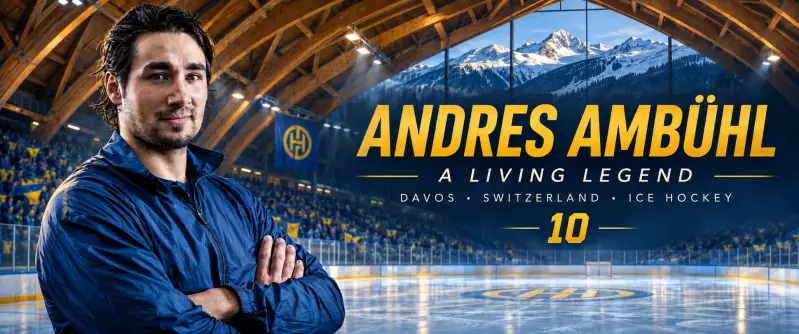
By the end, the numbers were extraordinary: 352 international appearances, 20 World Championships and 151 World Championship games. Yet understanding Andres Ambühl means looking beyond the records—to the Sertig Valley near Davos, his parents’ farm and a boy whose father’s favourite hockey club would become a defining part of his own life.
His journey took him from the Swiss mountains to North America, through three seasons with the ZSC Lions and eventually back to HC Davos. He became a six-time Swiss champion, won three Spengler Cups and earned three World Championship silver medals. When he retired in 2025, he had also played a record 1,322 games in Switzerland’s top division.
This is the story of a player who kept earning his place while hockey changed around him. Of an NHL ambition that remained unfulfilled, but an experience he still valued. Of strong roots in Davos alongside a genuine appreciation of life elsewhere. And of a man whose interviews repeatedly reveal the importance of teammates, family and the simple pleasure of playing.
In 2026, the International Ice Hockey Federation inducted him into its Hall of Fame, making an exception to the usual two-year waiting period after retirement. It was international recognition for a career rooted in Davos whose significance reached far beyond Switzerland.
Growing Up in the Sertig Valley: Where Andres Ambühl’s Story Begins
Long before Andres Ambühl played in front of thousands of spectators, he grew up on his parents’ farm in the Sertig Valley near Davos. As the eldest of four children and the only son, he helped with farm work from an early age. Physical activity and outdoor life were part of his childhood.
That upbringing was later frequently cited as an explanation for his remarkable stamina and durability. Ambühl himself was more cautious. Looking back, he acknowledged that his childhood might have helped shape his physical resilience, but he did not claim it explained everything. He also credited a naturally robust body and the good fortune of staying healthy.
His connection with HC Davos began through his father, an enthusiastic supporter who held a season ticket. The club was therefore part of family life before Andres became one of its best-known players.
Ambühl started playing hockey at seven. What began as a childhood interest gradually developed into a career that would take him far beyond the valley where he grew up.
The Sertig Valley remained an important reference point throughout his life. Even as an internationally recognised athlete, he was comfortable being described as a mountain man. Strong roots and curiosity about life elsewhere could coexist—as his later experiences in North America and Zurich would demonstrate.
His First Steps at HC Davos: From Junior Player to Swiss Champion
During the 2000/01 season, Andres Ambühl reached the HC Davos first team. The boy who had discovered the club through his family was now part of the squad Arno Del Curto was building into a Swiss championship contender.
It was a demanding environment for a young player. Davos won the Spengler Cup in December 2000, ending a wait stretching back to 1958. The club had ambitious goals, and Ambühl had to earn his opportunities alongside experienced professionals.
His international development also brought an early achievement. In 2001, he won silver with Switzerland at the Under-18 World Championship. Long before his senior national-team appearances reached record numbers, he had already helped a Swiss team compete for a world title.
In the spring of 2002, his first Swiss championship with HC Davos followed. Ambühl was just 18. Davos swept the ZSC Lions 4–0 in the final series to claim its first league title since 1985. Although he did not appear in every playoff game, he was part of the championship squad.
These early professional years also established the personal significance of his shirt number. Ambühl chose number 10 in honour of his idol, Russian star Pavel Bure.
That number would accompany him throughout his career. In time, Swiss supporters would associate it with Ambühl himself—a connection that would eventually receive a permanent place in the national team’s history.
2004: His First World Championship—Long Before the Records
When Andres Ambühl made his senior World Championship debut in 2004, he was 20 years old. The prospect of eventually appearing at twenty tournaments was beyond anything he imagined. His immediate challenge was simply to earn a place in the team.
Looking back, he described that first selection as an unexpected opportunity. His club season had ended early enough for him to complete the national team’s preparations and make his case for inclusion.
In the dressing room were established players such as goaltender Martin Gerber, Sandy Jeannin and Mark Streit. Ambühl now shared a team with men he had previously regarded as leading figures in Swiss hockey. Facing the stars of the major hockey nations added another dimension to the experience.
On 25 April 2004, he scored in Switzerland’s 6–0 victory over France—his first World Championship appearance. Yet regular selection was far from guaranteed. As a young player, he could not assume he would be on the ice rather than watching from the stands in the next game.
That uncertain beginning makes the career that followed all the more remarkable. Ambühl did not arrive with a plan to break world records. He took an opportunity, earned his place and kept returning for more than two decades.
He later stressed how much depended on health. A strong season could not secure a tournament appearance if injury intervened. Alongside his performances, he recognised the good fortune of having a body that allowed him to keep playing.
Under Arno Del Curto: Four Championships and the Courage to Move On
Between his first championship in 2002 and the spring of 2009, Andres Ambühl developed from a young squad member into an established Swiss international. At HC Davos, he experienced one of the most successful periods in the club’s modern history.
Further Swiss championships followed in 2005, 2007 and 2009. By the time he first left his hometown club at 25, Ambühl had already won four league titles.
The 2004/05 season was particularly unusual. The NHL lockout brought Joe Thornton, Rick Nash and Niklas Hagman to Davos. Ambühl belonged to a team in which international stars and Swiss players competed together for silverware. That spring, Davos defeated the ZSC Lions in the championship final.
His development under Arno Del Curto continued over several seasons. The former junior became a forward whose performances attracted attention beyond Switzerland. The 2009 championship brought this first Davos chapter to a successful conclusion.
Across the league campaign and playoffs that season, he scored 21 goals and contributed 27 assists, making him the team’s fifth-highest scorer. His growing influence was reflected in his offensive production.
Ambühl could have stayed with a successful club in familiar surroundings, close to home. Instead, he chose a new challenge. In May 2009, his move to the New York Rangers was announced.
It was a gamble. Four Swiss championships offered no guarantee of a place in the NHL. Ambühl nevertheless wanted to discover whether he could establish himself at that level.
North America 2009/10: The NHL Dream and a Difficult Year in Hartford
In May 2009, the New York Rangers signed Andres Ambühl. For the four-time Swiss champion, the contract offered an opportunity to pursue a place in the world’s leading hockey league.
But signing with the organisation did not lead to an NHL appearance. Ambühl spent the 2009/10 season with the Hartford Wolf Pack, the Rangers’ American Hockey League affiliate. He played 64 games there, while the hoped-for breakthrough into the team at Madison Square Garden remained out of reach.
This year matters precisely because his career involved more than championships and records. In North America, Ambühl experienced how success at home offered no guarantee of the same opportunities in a different environment.
Looking back near the end of his career, he wished the experience had unfolded differently. He suggested that another organisation might have been a better fit and that he should have listened more closely to his instincts. It was his personal assessment with the benefit of many years’ distance.
He nevertheless did not regret making the attempt. In his view, a player offered such an opportunity should take it. Even without the desired outcome, he knew he had accepted the challenge.
After one season, Ambühl returned to Switzerland. His next club, however, was not HC Davos. He joined the ZSC Lions, taking another step beyond the surroundings in which he had established himself.
Years later, he viewed those experiences together: the disappointing North American adventure had been followed by three years in Zurich that he remembered as enjoyable and important to his career.
Three Years in Zurich: A New Home and the 2012 Championship
After returning from North America, Andres Ambühl joined the ZSC Lions in 2010. His career continued in Switzerland, but for the first time with a club other than HC Davos.
He wore Zurich’s colours from 2010 to 2013. Those three seasons deserve their own place in his story. Describing Ambühl solely as a Davos institution overlooks a period he personally regarded as especially valuable.
In the spring of 2012, he won the Swiss championship with the ZSC Lions. After four titles with Davos, it was his fifth championship—and the only one he won with another club.
Years later, Ambühl spoke warmly about Zurich. He had felt comfortable there and described the organisation as having a family atmosphere. Returning to Davos was therefore neither an easy nor an automatic decision.
His recollections give depth to his attachment to home. He could settle elsewhere, build relationships and enjoy sporting success. Davos remained special without diminishing what his time in Zurich had meant to him.
After three seasons, he returned to HC Davos in the summer of 2013. He came back with broader experience: a year in North American professional hockey, a championship with Zurich and a perspective gained beyond the club where he had grown up.
His second Davos chapter would last longer than the first, strengthening the connection between Ambühl, the club and its supporters.
2013: World Championship Silver and a Return to Davos
The year 2013 brought two significant milestones for Andres Ambühl: his first senior World Championship final and his return to HC Davos.
In Stockholm, he won silver with Switzerland. For a player who had regularly represented his country at the tournament since 2004, the achievement carried particular significance. Years of international competition had finally brought a medal with the senior national team.
Ambühl had witnessed Swiss hockey’s development at close quarters. At his first World Championship, he had been a young player trying to establish himself alongside experienced internationals. Nine years later, he was among the veterans of a team that reached the final.
His return to Davos followed that summer. After one season in Hartford and three with the ZSC Lions, he wore blue and yellow again. He came back as a five-time Swiss champion and a newly crowned World Championship silver medallist.
Choosing his hometown club did not mean he was eager to leave Zurich behind. Looking back, Ambühl emphasised how comfortable he had felt there and how difficult the decision had been.
Davos welcomed back a player who understood the club while bringing experience from other organisations. His connection to home was entering a new phase.
This second Davos chapter would continue until the end of his playing career. The former junior increasingly became the experienced teammate and familiar presence whom a generation of supporters would associate with HC Davos.
2015: Captaining Davos to His Sixth Swiss Championship
Two years after returning to Davos, Andres Ambühl became Swiss champion again. In the spring of 2015, he captained HC Davos to the title. It was his fifth championship with the club and his sixth overall, including the title he had won with the ZSC Lions in 2012.
His role had changed considerably since his first championship in 2002. Then, he had been an 18-year-old at the beginning of his professional career. Thirteen years later, he carried the responsibilities of captain in another championship-winning team.
Those successes reflected different stages of his development. He had earned his place as a young player, become a Swiss international, attempted the move to North America and experienced another successful organisation in Zurich. He now brought that experience to his hometown club.
His importance to Davos continued beyond the championship celebrations. When the club announced his contract extension in late 2018, it described him as captain, driving force and a figure with whom supporters identified. During a difficult sporting period, his commitment provided continuity.
The 2015 championship proved to be the last of his playing career. His story at HC Davos, however, was far from finished. Ten more years followed, bringing changes in coaches, teammates and expectations.
Throughout those changes, Ambühl remained a familiar presence. His standing at the club grew through the time shared with teammates and supporters, including the seasons that ended without a trophy.
2022: The Day Andres Ambühl Made World Championship History
On 21 May 2022, Andres Ambühl stepped onto the ice in Helsinki for a special occasion. Switzerland faced Canada, and the 38-year-old forward was making his 120th appearance at the top-level World Championship.
He surpassed Germany’s Udo Kiessling, whose 119 games had been the previous record. No player had appeared more often in the competition than the forward from Davos.
Before the opening face-off, both teams remained on the ice for a tribute. A video celebrated Ambühl’s achievement, and representatives of the international and Swiss federations presented him with gifts. For a moment, attention centred on a player whose record had taken eighteen years to build.
His first World Championship appearance had come against France on 25 April 2004. Between that debut and the record-breaking game lay countless practices, club seasons and international preparations—and the repeated commitment to represent Switzerland after a demanding winter.
The result made the occasion even more memorable: Switzerland defeated Canada 6–3. Ambühl later recalled the combination of a personal milestone and a shared team success.
His record reflected the ability to keep earning selection. At each tournament, he had needed to remain healthy, maintain his performances and secure his place in the squad.
Nor was his story finished at 120 games. Ambühl continued playing, extending the record to 151 World Championship appearances before his retirement three years later.
2024: Another World Championship Silver—and a Record on 10 October
Eleven years after winning silver in Stockholm, Andres Ambühl reached another World Championship final with Switzerland in 2024. In Prague, he earned his second silver medal with the senior national team. At 40, he remained part of a squad competing for the world title.
Swiss hockey had changed considerably between those two finals. New leading players had emerged, and younger teammates had taken on responsibility. Ambühl connected this generation with the team that had reached the final in 2013.
A few months later, another milestone followed in HC Davos colours. On 10 October 2024, he made his 1,270th appearance in Switzerland’s highest league against SC Bern, surpassing Beat Gerber to become the sole record holder.
The date neatly matched his shirt number: Davos’s number 10 reached the landmark on 10 October. Behind that coincidence stood almost a quarter of a century in top-level hockey.
Ambühl had accumulated his appearances since the 2000/01 season. His journey included a year in the AHL, three seasons in Zurich, his return to Davos and numerous international tournaments.
He also contributed on his record night, registering an assist on Matej Stransky’s early opening goal as Davos went on to win.
The celebration therefore honoured a player who was still actively contributing. His career total remained unfinished: by his final National League appearance in April 2025, Ambühl had extended the record to 1,322 games.
2025: One Last Goal in His Farewell to HC Davos
In February 2025, Andres Ambühl announced that he would retire at the end of the season. After almost a quarter of a century in top-level hockey, every remaining appearance carried added significance.
His final club game came on 10 April 2025. In Game 6 of the playoff semi-final against the ZSC Lions, Davos fought to keep its season alive. His Swiss club career would end against the very organisation with which he had won the championship in 2012.
In the 56th minute, Ambühl scored once more. His deflection reduced the deficit to 6–3, offering Davos a late glimmer of hope. The game nevertheless ended in a 6–4 defeat. Zurich advanced to the final, while the HCD’s season was over.
It was Ambühl’s 1,322nd appearance in Switzerland’s highest league. That total included 221 playoff games, reflecting how often his seasons had extended into the decisive championship rounds.
Marc Wieser also ended his playing career that evening. Davos was saying farewell to two long-serving players whose names had become closely associated with the club.
For Ambühl, however, the end of club hockey did not yet mean his final appearance as a player. Another World Championship remained a possibility. After the HCD’s season ended, he confirmed his willingness to represent Switzerland once more.
One final international chapter awaited: his twentieth World Championship.
His Final World Championship: A Hat-Trick at 41 and One Last Final
In May 2025, Andres Ambühl travelled to his twentieth and final World Championship. His club career was over, but one last tournament in Switzerland’s colours lay ahead.
On 18 May, he produced a memorable performance against Hungary, scoring three times in a 10–0 victory. At 41 years, eight months and five days, Ambühl became the oldest hat-trick scorer in World Championship history.
Even after two decades in the competition, he could still establish a new milestone. His goals also contributed to a campaign that would take Switzerland to another final.
On 25 May 2025, Ambühl faced the United States in the gold-medal game in Stockholm. It was his 151st World Championship appearance and the final game of his career. Switzerland lost in overtime, leaving him with silver, as in 2013 and 2024.
Afterwards, Ambühl focused on the team. His personal farewell came second to the shared ambition: Switzerland had wanted gold. The end of his career did not lessen the disappointment of coming so close.
He left the ice with his third World Championship silver medal and an extraordinary record: 352 international appearances, twenty World Championships and 151 games at those tournaments.
More than twenty years separated the young debutant of 2004 from this final appearance. Ambühl had witnessed—and contributed to—Switzerland’s development into a team capable of repeatedly reaching the final. His last game took place on the tournament’s biggest stage, with the world title at stake.
The Man Behind Number 10: Family, Respect and the Joy of Playing
Telling Andres Ambühl’s story through records alone leaves out an important part of his life. In interviews, he also spoke about family, teammates and what continued to make hockey enjoyable.
Long absences were part of the cost of his international career. Towards the end of his playing days, Ambühl explained that his two daughters had begun asking when he would come home. Every additional World Championship also meant weeks away from his family.
At his induction into the IIHF Hall of Fame in 2026, he thanked his wife for her support and the sacrifices made during his absences, particularly after they became parents. The ceremony acknowledged a career sustained partly by people who rarely stood in the spotlight.
Ambühl also expressed a clear view of sporting relationships. Opponents were competitors during a game; afterwards, mutual respect should remain. He appreciated being valued by supporters of other clubs.
As a father, he wanted his children to play outside and spend time with others. At the same time, he recognised that digital devices would be part of their lives. He favoured finding a balance rather than rejecting how childhood was changing.
Perhaps his most revealing answer concerned whether hockey had ever really felt like work. For Ambühl, it had remained a source of play and enjoyment. Through decades of professional competition, he had retained the pleasure that first brought him onto the ice.
A Number to Remember: Switzerland Retires Ambühl’s Number 10
After retirement came an honour unprecedented in Switzerland’s senior national team. At the Swiss Ice Hockey Night in 2025, the federation announced that Andres Ambühl’s number 10 would no longer be issued.
It was the first officially retired number in the team’s history—a lasting recognition of his contribution to Swiss hockey.
For Ambühl, the number already carried a personal story. As a young player, he had chosen it in honour of his idol, Pavel Bure. Over the following decades, Swiss supporters increasingly associated it with Ambühl himself.
The tribute recognised an exceptional international career: 352 appearances for Switzerland, twenty World Championships, 151 World Championship games and three silver medals. He had also represented his country at five Olympic Winter Games.
His popularity extended beyond his own club’s supporters. According to Swiss Ice Hockey, Ambühl was voted Most Popular Player nine times during his career.
Retiring his number preserves a visible connection with that career. Future players will wear Switzerland’s colours, write their own stories and pursue international success. Number 10 will remain associated with a player who represented the team for more than two decades.
For the boy from the Sertig Valley, it was a remarkable form of recognition. His playing days were over, but his place in the national team’s history was secure.
2026: Induction into the IIHF Hall of Fame
On 31 May 2026, Andres Ambühl received one of international hockey’s highest honours: induction into the IIHF Hall of Fame in Zurich.
Players normally have to wait at least two years after retirement before becoming eligible. For Ambühl, the Historical Committee made an exception. Just one year after his final World Championship appearance, his career was recognised on the international stage.
The IIHF highlighted his remarkable tournament records: 151 World Championship games and twenty appearances at the event. His silver medal with Switzerland’s under-18 team in 2001 and three subsequent silver medals with the senior national team also formed part of that achievement.
In his speech, Ambühl described the freedom and happiness he had felt while playing hockey. For a Swiss player of his generation, the World Championship had offered a special opportunity to measure himself against the best.
His words gave a personal perspective on the records. Behind the numbers were years of accepting challenges, facing strong opponents and trying to improve alongside his teammates.
The ceremony took place on the final day of Switzerland’s home World Championship. With his own last tournament only a year behind him, the occasion brought his playing career and its lasting recognition together.
The former Davos junior was now a member of international hockey’s Hall of Fame. His story had begun in the Sertig Valley; its significance had reached far beyond his hometown club and country.
Conclusion: The Legacy of Andres Ambühl
Andres Ambühl’s career can be summarised in extraordinary numbers. Its meaning becomes clearer through the experiences behind them: childhood in the Sertig Valley, his first games for HC Davos, four early championships, a difficult year in Hartford, success in Zurich and a long return to his hometown club.
His journey included disappointment. The NHL dream remained unfulfilled. Three World Championship finals ended with silver, and his last club game was a defeat. Those experiences belong alongside the trophies, records and honours.
Over the years, Ambühl repeatedly had to earn his place. The young prospect became an established international, a captain and eventually an experienced teammate for a new generation. Staying competitive for so long required him to keep adapting.
For Davos, he remains a player from the region who ventured elsewhere, gained experience and returned. For Switzerland, his number 10 represents more than two decades of international appearances. His induction into the IIHF Hall of Fame recognises that contribution beyond national borders.
Perhaps one of the most revealing aspects of his story is that he retained his enjoyment of the game. World records were the outcome of his career. Its beginning was a child who wanted to play hockey.
That child became “Büeli”: Swiss champion, World Championship record holder and one of the defining figures of Swiss ice hockey.
Sources and Further Reading
This profile draws on publications by the International Ice Hockey Federation, reporting by SRF and Keystone-SDA, and interviews with Andres Ambühl. Personal reflections are based on his published statements. Some sources are available only in German.
• IIHF: Tribute Following His Record-Breaking 120th World Championship Game
https://www.iihf.com/en/events/2020/wm/news/35146/andres_ambuhl_king_of_the_worlds
• IIHF: Hall of Fame Induction in 2026
https://www.iihf.com/en/events/2023/wm/news/74775/welcome_iihf_hall_of_fame_class_of_2026
• Keystone-SDA / watson: Career Interview with Andres Ambühl, May 2025
https://www.watson.ch/sport/interview/799139756-eishockey-wm-andres-ambuehl-ueber-seine-zukunft-und-die-hockey-nati
• SRF: Career Review After 1,322 Games in Switzerland’s Top Division
https://www.srf.ch/sport/eishockey/national-league/nach-1322-spielen-rekordmann-ambuehl-tritt-ab
• SRF: Records and Career Milestones
https://www.srf.ch/sport/eishockey/national-league/rekordmann-ambuehl-in-zahlen-titelkaempfe-ohne-ende-und-liebling-der-fans
• HC Davos: Official Club History
https://www.hcd.ch/de/der-hcd/geschichte
Profile updated: November 2026.
Picture: AI-edited portrait of Andres Ambühl. The Davos-inspired arena background, lighting and lettering were created using artificial intelligence and do not depict an actual photographed scene.
Add comment
Comments