The History of HC Lugano: From Its Beginnings in 1941 to Grande Lugano and Seven Swiss Titles
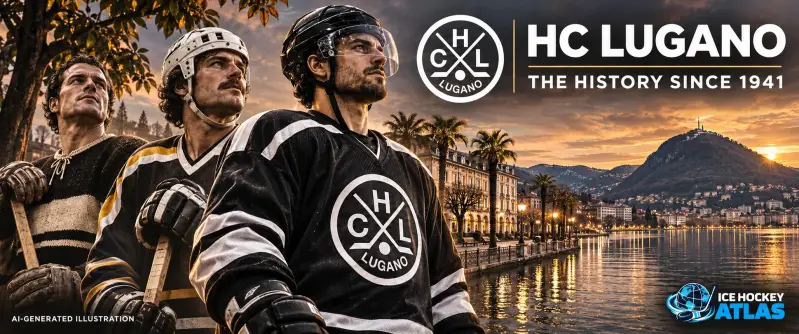
HC Lugano since 1941: three fictional hockey players from different eras against an artistic view of Lugano and Lake Lugano. AI-generated illustration featuring the HCL crest; not a historical photograph or a portrayal of specific players.
To understand the history of HC Lugano, you need to look further back than the championship celebrations at the Resega. The story begins on natural ice, passes through changing home rinks and the search for a lasting place in Swiss hockey, and reaches a team that challenged the standards of an entire league during the 1980s. Later came an unforgettable all-Ticino final, European nights, dramatic comebacks and the long pursuit of an eighth championship.
The Bianconeri — the Black and Whites — have never been defined by trophies alone. The club’s identity also includes the Resega, the Curva Nord, the rivalry with Ambrì-Piotta, exceptional international players and personalities who became part of its fabric over decades. Defeats, periods of upheaval and the successful but subsequently dissolved women’s club belong to this history too. This detailed account explores the major eras and the connections between them. Information current to 26 November 2026.
1941: A Hockey Club Is Founded During the War
The Meeting at Restaurant Apollo
HC Lugano was founded on 11 February 1941. The meeting took place at Restaurant Apollo on Via Stauffacher, opposite the former Kursaal. Natural ice and modest local arrangements shaped the early years. The original playing site was the pond at Muzzano; in 1948, activities moved to Loreto. Source: Official club history.
These beginnings explain why the modern image of a professionally organised National League club is an imperfect starting point. First, the conditions needed for hockey to happen regularly had to be created. Ice, equipment, opponents and somewhere to play were far from guaranteed. The club grew from the commitment of people who wanted to establish their sport in a region whose identity was by no means defined solely by winter activities.
A Ticino Identity Within a Swiss Winter Sport
Lugano’s development is also a story of regional ambition. A club from Italian-speaking Switzerland entered a sport whose established centres lay elsewhere. This did not automatically produce a fixed playing philosophy. It did, however, create a distinctive cultural setting: the language, the colours, the relationship with the city and, later, a particularly intense shared experience in the stands.
Bianconeri initially describes the club colours. Over the decades, it became shorthand for a community. People using the word mean more than a team name on a game sheet. They mean belonging to a club whose greatest triumphs and disappointments have often reached far beyond the spectators inside its rink.
From Natural Ice to the Resega
1957 Provides a More Permanent Foundation
The opening of the first artificial Resega rink in 1957 was a crucial infrastructure milestone. The rink initially had no roof. The city’s current information explicitly distinguishes this original facility from the newer arena inaugurated in 1995. That distinction matters: in historical accounts, Resega refers to a location with several stages of development, rather than a building that has remained unchanged since the 1950s. Source: City of Lugano information on the rink.
Artificial ice transformed the prospects for training and junior development. The club could plan more reliably across a season and pursue improvement more systematically. In retrospect, that change looks less spectacular than a championship-winning goal. For long-term development, however, it was fundamental. Without a dependable ice surface, sporting ambitions remain subject to conditions a team can do little to control.
Mezzovico and the Return to Lugano
The club history also records the years in Mezzovico, where Lugano played in a covered rink from the mid-1970s. After the roof collapsed following exceptional snowfall in February 1978, the club returned to the Resega. Changes of playing venue therefore extended beyond the founding years into the period immediately before the developments that would eventually produce Grande Lugano. Source: Official account of the 1970s.
Promotions Before the Great Breakthrough
1964: Young Alfio Molina and Nationalliga B
Lugano won promotion to Nationalliga B in 1964. Already in goal was fifteen-year-old Alfio Molina. His importance stretches far beyond that first milestone: the club honours his 24 seasons from 1963/64 to 1986/87, a career connecting the early promotion years with the first championships. Source: HCL Hall of Fame.
His career reveals a development that a list of trophies alone cannot show. The same player experienced a club emerging from the lower divisions and later a team setting national standards. Such figures connect generations. For some supporters they represent the pioneering years; for others they already belong to the first successful Lugano.
1971 and 1982: Two Different Attempts to Reach the Top
The first promotion to the highest division came in 1971. Lugano only established a lasting top-flight presence after returning in 1982. Those two promotions should therefore not be compressed into a single event. The first proved that the club could reach the elite. The second became the starting point for sustained development. Sources: HCL Hall of Fame and historical account in Rivista di Lugano.
The distinction between reaching a level and becoming established there is central to this story. Requirements for the squad, training arrangements and financing rise with the division. Winning promotion does not solve these challenges automatically. Lugano’s later breakthrough depended on bringing sporting ambition and organisational development into closer alignment.
Geo Mantegazza Changes the Club’s Perspective
A New Chapter Begins in 1978
Geo Mantegazza became president in 1978 and remained the club’s operational leader until 1991. His tenure included promotion in 1982 and four championships between 1986 and 1990. The club’s official tribute emphasises his influence through professionalisation and the ambition to challenge the established powers consistently rather than merely upset them occasionally. Source: HCL’s tribute to Geo Mantegazza (Source).
One striking signal was the signing of Mark Pavelich following the American Olympic triumph in 1980. Internationally known players were intended to bring sporting substance as well as attention. Those transfers need to be understood in their original setting: Lugano was signalling that it had no intention of accepting a modest supporting role in national hockey.
Why His Influence Reached Beyond Lugano
The later expression Grande Lugano consequently describes more than a good team. It refers to a period in which financing, training standards, international reinforcements and sporting objectives worked together. RSI explicitly interprets this development as a modernising force that required other Swiss clubs to respond. Source: RSI on the fortieth anniversary of the first title.
That does not mean other clubs had previously worked without professionalism. It means a competitor raised the demands. Anyone hoping to beat Lugano had to confront its pace, preparation and quality. The ambition of one club thus created additional competitive pressure throughout the league.
John Slettvoll and the Swedish Influence
A Coach with a Clear Vision
John Slettvoll arrived in Lugano in 1983. Kent Johansson joined the team with him, followed a year later by Mats Waltin. The coach and his Swedish key players became the sporting core of the coming success. Lugano finished fourth in 1984 and second in 1985 before breaking through in 1986. Source: RSI’s retrospective on the first championship.
John Slettvoll represents a more structured understanding of team performance. A star could still decide a game, but needed to operate within a functioning whole. Combining different roles was particularly important: a prolific forward, an intelligent puck-moving defender and dependable Swiss regulars could become more than the sum of their individual careers when their contributions worked together.
Johansson, Waltin and the Swiss Foundation
Kent Johansson became the symbol of the attack, Mats Waltin a defining figure in building play from defence. Yet the success was not exclusively Swedish. Jörg Eberle, Sandro Bertaggia and captain Beat Kaufmann are among the names without which the team cannot be properly understood. Their profiles show different backgrounds brought together in a successful Lugano side.
This was therefore more than an import-led project. International class expanded what was possible, while the quality and reliability of the rest of the squad determined how effectively those possibilities were used. The subsequent championships demonstrated that Lugano possessed more than a one-off transfer success.
1986: The Night in Davos
Switzerland’s First Playoff Champions
The 1985/86 season introduced playoffs to Switzerland. Lugano first won the regular season, then prevailed in the short best-of-three series. Sierre were beaten 7–2 and 7–3 in the semi-final, followed by victories of 5–0 and 7–5 against Davos in the final. The triumph on 1 March 1986 was therefore both Lugano’s first championship and the first Swiss title decided under the new playoff system. Source: RSI’s record of the inaugural playoffs.
From a Deficit to a 7–5 Victory
The deciding game in Davos became a foundational memory of the successful era. Lugano trailed 4–2 but won 7–5. Kent Johansson scored four goals and Jörg Eberle two. Thousands of travelling supporters saw their club become champions for the first time in one of Switzerland’s most traditional hockey settings. The return to Ticino and the reception at the Resega remain part of the story of that night.
The fortieth-anniversary retrospective credits Kent Johansson with 92 points in 39 appearances across the season. The figure illustrates both his production and his exceptional standing as a player whose name remains inseparable from the first title. Source: RSI on the 1986 championship team.
1987, 1988 and 1990: Champions Become a Dynasty
1987: Confirmation Against Kloten
A first championship can be the culmination of a special season. A second demonstrates that a club can withstand the expectations it has created. Lugano won again in 1987, this time against Kloten. The opposition now faced the defending champions rather than an emerging challenger. The team had to prove it could remain successful under those changed circumstances. Source: Official HCL trophy record.
1988: A Third Consecutive Title
Another championship followed in 1988, again against Kloten. A successful team had become a defining era. Three consecutive titles require outstanding performance alongside the ability to absorb squad changes and sustain demanding internal standards. Grande Lugano had now confirmed its leading position over several winters.
1989 and 1990: Defeat and a Response
Lugano lost the 1989 final to Bern, then reclaimed the title against the same opponents in 1990. From 1986 to 1990, the Bianconeri therefore reached five consecutive playoff finals and won four championships. The defeat in between belongs in the account too. Lugano’s strength also lay in ensuring that the end of a winning sequence did not immediately end the whole successful period. Sources: HCL’s presidential and historical account and Lugano Region.
European Ambitions and a More Difficult 1990s
Lugano Seeks an International Test
The Swiss titles opened the European stage. Those competitions should not be confused with today’s Champions Hockey League. The European Cup and subsequent European Hockey League had their own formats and qualification routes. For Lugano, however, they posed the same fundamental challenge: quality developed in Switzerland now had to stand up against different international styles.
The Spengler Cup also became part of this history. In 1991, Lugano reached the final and lost 5–2 to CSKA Moscow. The organiser records the encounter in its official tournament history. Facing one of the great names of Soviet hockey gave the appearance particular significance, even though it did not produce a tournament victory. Source: Official Spengler Cup history.
Expectations Remain as Success Becomes Less Consistent
A dynasty changes the measure of achievement. A semi-final appearance that would once have represented progress can suddenly feel disappointing. Lugano faced precisely that shift during the 1990s. The memory of four titles remained vivid while opponents, players and sporting leadership changed.
The later second period of success was consequently more than a simple extension of Grande Lugano. It had to be built with different players and a new sporting configuration. That generational transition explains why nine years separated the 1990 title from the next championship, and why 1999 deserves its own distinct chapter.
1995: A New Resega and a Profound Setback
The Modern Arena
The new Resega opened in 1995. The City of Lugano describes a multipurpose venue accommodating events beyond hockey. Within the club’s history, it marks the transition from the older home rink to more modern infrastructure. The Resega name remained, connecting different generations of spectators. Source: City of Lugano arena information.
Pat Schafhauser’s Injury
On 5 December 1995, Pat Schafhauser suffered a severe spinal injury in Davos. The defenceman was left using a wheelchair. His retired number 4 is a reminder that a club honours its important figures through more than goals and trophies. Source: HCL’s retired jerseys.
This event requires a different tone from a sporting disappointment. A lost series can be corrected the following winter; the consequences of such an injury affect an entire life. A serious club history therefore needs room for responsibility towards people alongside competition. In Lugano, remembering Pat Schafhauser represents that part of the community.
1999: The All-Ticino Final Against Ambrì-Piotta
An Entire Canton Follows One Series
The 1999 final was more than another title decider. Lugano and Ambrì-Piotta competed directly for the Swiss championship. Ambrì had won the regular season, while Lugano first had to fight its way through the playoffs. With Jim Koleff behind the bench, the Bianconeri had a team whose experience and defensive stability became particularly valuable at the decisive stage. Source: RSI’s retrospective on the Ticino final.
Five Games to a Fifth Championship
Lugano won the opening game at the Valascia 3–2 in a shootout. Ambrì responded with a 5–3 victory at the Resega. The third game, back in the Leventina, again went to Lugano, this time 3–2 in overtime. A 4–0 home win followed. On Easter Monday, 5 April 1999, Lugano secured the title with a 3–1 victory at the Valascia. The series finished 4–1. Source: Detailed final retrospective in Rivista di Lugano.
The distribution of victories is striking: Lugano won all three away games. The decisive moments repeatedly came at its rival’s rink. In a derby final, that illustrates how little familiar home surroundings alone determine a series when another team can impose its game under exceptional pressure.
The Faces of the Triumph
Cristobal Huet in goal, Peter Andersson in defence and Gaetano Orlando in attack were among the defining figures. Jim Koleff combined their qualities into a team that did not always need to be more spectacular but won the situations that mattered. The 1999 championship was Lugano’s fifth and its first since the end of the four-title golden era. Source: RSI on the final and its key players.
1999/2000: A European High Point and a Lost Swiss Final
The Top Four Tournament at the Resega
In the 1999/2000 European Hockey League, Lugano reached the final tournament of the best four teams and also acted as host. HCL lost its semi-final to Sparta Prague in overtime; Metallurg Magnitogorsk won the competition. Those names illustrate the level at which the Bianconeri were then competing. Source: Official club history of the European campaign.
Reaching this stage should not be mistaken for winning a European title. It nevertheless remains significant: Lugano qualified for a decisive tournament phase and brought leading international opposition to the Resega. Europe provided a further benchmark alongside the national championship and gave the club visibility beyond Switzerland.
Zurich Becomes a Recurring Obstacle
Lugano lost the 2000 Swiss final to the ZSC Lions. Just a year later, the same teams met in the last series again. These results belong to a broader story: Lugano remained strong enough to compete for the championship, but had to learn that even an impressive starting position did not guarantee a trophy. Source: Lugano Region’s record of final appearances.
2001: A Championship Almost Within Reach
Lugano led the 2001 final series 3–1 and needed one more victory. The ZSC Lions turned the series around. In the deciding game in Lugano on 7 April, the outcome came in overtime: Zurich won 2–1 and took the championship. Contemporary reporting and the Zurich club’s retrospective document how a comfortable series lead became one of Lugano’s most painful final defeats. Sources: Contemporary swissinfo report and ZSC’s account of the 2001 title.
For Lugano, the final offered a sharp contrast with 1999. Then, tight games had been won at the decisive moment; now, several opportunities to finish the series slipped away. Such defeats explain later expectations better than a blanket description of an impatient club. A team that has seen the trophy almost within its grasp assesses the next unsuccessful season differently from one still some distance from a final.
2003: The Sixth Title Under Larry Huras
A Coaching Change Alters the Season
Larry Huras took over from Jim Koleff during the 2002/03 season. The playoff route led past Kloten and the ZSC Lions into a final against Davos. The personnel foundation was changing too: Lugano’s next successful team would not simply repeat the 1999 formula. Source: Keystone-SDA’s retrospective on Lugano’s second title era.
Four Wins After Two Defeats
Davos won the opening two final games. Lugano answered with four consecutive victories to take the series 4–2. The concluding home win finished 4–0. Ronnie Rüeger in goal and Petteri Nummelin in defence were among the important figures in the achievement. Source: Official HCL account of the 2003 championship.
The sixth championship was also a fitting conclusion to Sandro Bertaggia’s playing career. He had played continuously for Lugano since 1985/86 and contributed to six championships. His career connected the first Grande Lugano with the next successful generation. Few players can provide such a bridge between two eras with different teams and sporting circumstances. Source: HCL’s tribute to number 2.
2004 and 2005: Why a Strong Regular Season Is Not Enough
Lugano returned to the final in 2004, this time losing to Bern. In 2005, the playoffs ended in the quarter-finals against the same opponents. A Keystone-SDA retrospective places these years within a striking pattern: Lugano could dominate the regular season without automatically turning that strength into a championship. Source: Analysis of the successful and unsuccessful playoff years.
This is essential to understanding the whole second period of success. Between 1999 and 2006, Lugano won three championships but also lost major opportunities. Its teams were not good only in the seasons that ended with a trophy. Conversely, a strong season record could not replace the ability to find decisive answers in a short series.
2006: The Derby Comeback and the Seventh Championship
Ambrì Pushes Lugano to the Brink
The quarter-final against Ambrì-Piotta placed Lugano in a desperate sporting position. Larry Huras was replaced by Harold Kreis after two defeats. Nevertheless, the deficit initially grew to 3–0 in games. Lugano now faced elimination by its cantonal rival in a season that had again begun with high ambitions. Source: Keystone-SDA on the 2006 quarter-final.
Four Victories Save More Than a Single Round
HCL won the next four games and reversed the series to 4–3. EHC Klotenwere then beaten 4–1 in the semi-final, followed by Davos by the same margin in the final. A season that had seemed lost in the quarter-finals ended with the seventh championship. Sources: HCL trophy record and retrospective on the second title era.
This comeback is often compared with later Swiss recoveries. The round needs to be identified correctly: Lugano overturned a quarter-final in 2006, not a final. That distinction does not diminish the achievement, but prevents a misleading comparison. Its particular importance lies in the way rescuing the series opened the route to winning two further rounds and the championship itself.
A Team with Outstanding Attacking Quality
Glen Metropolit brought creativity and production to the attack. With Ville Peltonen and Petteri Nummelin, Lugano also possessed exceptional Finnish quality. Career profiles and the club’s accounts reveal the depth of international experience assembled in the squad. Yet famous names alone cannot explain the title. After the coaching change, that quality had to function again as a team under immediate threat of elimination. Sources: HCL Hall of Fame and Ville Peltonen’s profile (Source).
The Legends Behind the Championships
Alfio Molina: A Link Between Promotion and Championships
Alfio Molina is one of the strongest personal connections between the building years and Grande Lugano. Already in goal as a teenager for promotion to the NLB, he remained with the club during its first championship seasons. His number 1 was retired. The significance of that honour also lies in the duration of his service: it recognises a player who helped carry the club through markedly different sporting circumstances.
Sandro Bertaggia: Six Titles and Number 2
Sandro Bertaggia represents eighteen consecutive Lugano seasons from 1985/86 to 2002/03. He won six championships during that period. His contribution therefore extends beyond one celebrated game. He belonged to the Swiss foundation that made repeated success possible while international reinforcements and teammates around him changed.
Petteri Nummelin: A Defenceman as Playmaker
Petteri Nummelin played for Lugano in two spells: from 2001 to 2006 and from 2008 to 2013. The championships of 2003 and 2006 form part of his Swiss career. His style exemplifies the defenceman who does more than stop attacks: he creates solutions through vision, precise passing and the ability to disrupt an opponent’s organisation. His directly linked career profile adds the international context to those memories.
Julien Vauclair: Development, Return and Leadership
Julien Vauclair wore Lugano’s jersey over a long period between 1997 and 2020, interrupted by his years in North America. His championships with Lugano came in 1999 and 2006. By retiring his number 3, the club honoured another figure whose significance extends beyond a single successful team. Source: Julien Vauclair’s career profile (Source).
Hirschi, Sannitz, Conne and Näser: Everyday Continuity
Steve Hirschi, Raffaele Sannitz, Flavien Conne and Andy Näser also have retired numbers. They represent different contributions: leadership in defence, work at centre, service in difficult game situations and longstanding dependability. A club history told only through leading scorers can easily overlook how important these qualities are to a functioning team.
The full tributes to numbers 1, 2, 3, 4, 8, 33, 38, 40 and 44 can be found at HC Lugano. This list is not a ranking of personal or sporting worth. It shows the figures the club has permanently incorporated into its visible memory.
After 2006: The Long Distance Between Ambition and Reality
Why Earlier Recipes No Longer Guaranteed Success
The seventh championship did not lead to another dynasty. HCL remained a club with high expectations, but experienced repeated early playoff exits and changes behind the bench. One understandable temptation was to reproduce previous turning points: if a coaching change had brought a title in 2003 and 2006, a new voice could appear particularly promising.
That reasoning has limits. A change can quickly alter roles and release energy, but does not automatically replace the long-term construction of a team. The years after 2006 can therefore also be read as a search for balance between responding rapidly to poor results and allowing time to build a sustainable sporting foundation.
2011: A New President
Vicky Mantegazza became president in 2011. The official presidential record documents the transition. The Mantegazza name thus remained closely connected with the club, but under considerably changed competitive conditions. The task was no longer to build the first Grande Lugano, but to develop an established organisation carrying a formidable past. Source: HCL presidential history.
2016: Returning to the Final
A Difficult Start Is Overcome
The 2015/16 season changed direction after a poor beginning. Doug Shedden took over the team, which subsequently regained stability and confidence. Elvis Merzlikins in goal and Linus Klasen in attack were among the faces of this period. Their directly linked profiles allow these Lugano years to be placed within their wider careers.
The Spengler Cup as an Intermediate Milestone
Lugano reached the Spengler Cup final at the end of 2015 and lost to Team Canada. A year later, HCL returned to the tournament final and again lost to the Canadians. Together with 1991, these make three final appearances, which need to be distinguished from the domestic championship record. Sources: Lugano Region’s tournament record and Spengler Cup winners and finalists.
Bern Wins the Last Series
In spring 2016, Lugano reached a championship final for the first time in ten years. It began with a 5–4 home win against Bern. SCB then won four consecutive games to take the series 4–1. The last game at the Resega finished 3–2 to Bern. Sources: SRF on the opening game and SRF on Bern’s title victory.
An important change nevertheless remained for Lugano. The club had experienced a season in which the final sporting question was whether another championship was possible, rather than why the team had gone out early. That proximity to the ultimate objective clearly distinguished 2016 from many preceding years.
2018: All the Way to Game Seven Against Zurich
Under Greg Ireland, Lugano reached another final in 2018, this time against the ZSC Lions. Trailing 3–1 in the series, the Bianconeri won twice to force a seventh game. The deciding evening on 27 April took place in Lugano. Zurich won 2–0 and took the series 4–3. Sources: SRF on forcing game seven and SRF on the deciding game.
The parallel with 2001 is obvious: another final against Zurich was decided in a seventh game in Lugano. The route there, however, was different. In 2001, HCL lost a substantial lead; in 2018, it fought back from a difficult position itself. The fact that both series ended in home defeat should not obscure those contrasting performances.
Resega and Cornèr Arena: Two Names, One Place of Memory
The arena has been called Cornèr Arena since 2018. Resega has remained in the vocabulary of many supporters. For historical writing, it makes sense to use the contemporary name while explaining the present designation. The championship celebrations of 1999, 2003 and 2006 took place at the Resega; a visitor today attends a game at Cornèr Arena.
The naming partnership has since been extended until 2039. The official announcement also illustrates the importance of long-term commercial relationships to a modern club. The arena is simultaneously a competition venue, training base, economic foundation and emotional reference point. Source: HCL on the naming partnership through 2039.
The Curva Nord and the Ticino Derby
More Than a Noisy Backdrop
The Curva Nord belongs to HCL’s visible identity. Songs, flags and shared rituals give a game a setting that cannot be read from the standings. The club’s historical accounts connect its development closely with the new momentum of the late 1970s and early 1980s. Source: HCL’s remembrance of the emergence of Grande Lugano.
In sporting terms, a supporters’ section has a dual role: it can lift a team, but also make the scale of expectations unmistakable. People who have experienced years of major final series react differently to defeat from those whose club is challenging for a playoff place for the first time. That tension forms part of daily life at a traditional club with a strong expectation of success.
Ambrì-Piotta as a Lasting Reference Point
The rivalry between Lugano and Ambrì combines geographical proximity with different local identities. It should not be reduced to a simplistic city-versus-mountain-village formula. Both clubs have their own traditions, supporters beyond their immediate surroundings and histories extending beyond the derby. Direct encounters nevertheless carry additional weight because they provide such an immediate measure of each club’s position within Ticino hockey.
The 1999 final and 2006 quarter-final explain why certain series resonate more strongly in collective memory than any arbitrary number of regular-season wins. Sporting progress was at stake, but so was the question of who would have the last word in the cantonal rivalry at a historic moment.
Junior Development and the Route to the International Stage
HCL’s history is frequently told through the stars it signed. Alongside them stands the question of which players the club develops itself and helps into the first team. The careers of Julien Vauclair, Raffaele Sannitz and Luca Fazzini illustrate different forms of that connection. Their importance comes from more than a birthplace or an early junior jersey: it lies in the transition to responsible roles in senior hockey.
Elvis Merzlikins represents another route. An international junior player progressed through Lugano’s structures and first team before reaching the NHL. His career record documents his HCL youth years and subsequent move to North America. Such a career is both a sign of development quality and a challenge for the club, because particularly successful players may eventually move to a larger stage. Source: Elvis Merzlikins career archive (Source).
Lasting identification and international careers are not opposites. A club needs players who stay, alongside development pathways that open further opportunities for talented prospects. The historical numbers beneath the arena roof and the careers of former juniors tell two different, complementary parts of the same development story.
Ladies Lugano: Eight Championships and a Bitter Ending
A Successful Chapter in Its Own Right
Women’s hockey in Lugano deserves its own place in the account. The Ladies won eight Swiss championships between 2006 and 2021: in 2006, 2007, 2009, 2010, 2014, 2015, 2019 and 2021. This is a separate record from the men’s seven championships and should not be combined with it. Sources: SRF on the 2021 title and Rivista di Lugano’s retrospective.
The women’s club was organisationally separated from HCL SA in 2018. Accurate terminology is especially important for that reason: a shared Bianconeri history does not mean the same legal and financial structure existed throughout. The achievements remain part of Lugano’s hockey culture but need to be considered within their respective organisational setting.
Operations End in 2024
Permanent closure for financial reasons was announced in April 2024. The Ladies had previously withdrawn from the promotion-relegation series against Zug. A restart in the second division was not pursued. The dissolution demonstrates particularly clearly that even an exceptional trophy collection does not guarantee lasting financial security. Source: SRF on the closure of the women’s club.
This part of the story must not disappear behind the men’s finals. Speaking of Lugano’s hockey tradition also means recognising the players, coaches and officials who made national excellence possible over many years. The end of operations changes the present, but does not erase the earlier achievements.
The Pandemic, Setbacks and the Recent Past
2020: A Season Without a Playoff Conclusion
The pandemic interrupted Lugano’s season in 2020 too. The scheduled playoffs were cancelled, after which games without spectators and other restrictions shaped Swiss professional sport. In the club history, the period appears as both a sporting interruption and an organisational and economic burden. Source: HCL’s account of the pandemic period.
For a club whose home games depend so strongly on the immediate shared experience, the absence of spectators was more than a visual change. It affected matchday culture, income and contact with the people who had supported the organisation for decades. The impact of these years cannot therefore be fully understood through a final league table.
2025: Suddenly, Survival Is at Stake
The 2024/25 season ended with Lugano facing Ajoie in the playouts rather than competing for the title. After six games, HCL prevailed 4–2 in the series. Lugano won the decisive away game 2–1, securing its place in the National League. Source: SRF on the conclusion of the playout series.
This low point belongs in a detailed club history precisely because it contrasts so sharply with the image of seven-time champions. Big names, high expectations and past titles cannot prevent a season from going fundamentally wrong. Securing survival was necessary, but did not remove the need for a careful examination of the causes.
2026: Sporting Renewal Also Needs a Financial Foundation
For the 2025/26 financial year, HCL SA reported operating revenue of approximately CHF 22.27 million and a net loss of CHF 193,350. The club also announced the completion of a financial restructuring implemented over several seasons. These figures are a snapshot of the published annual accounts rather than a prediction of future team performance. Source: Official results of the 2025/26 HCL general meetings.
The figures illustrate the scale of a professional club today. Sporting decisions must fit together with staffing, junior development, infrastructure, marketing and long-term funding. That is a very different setting from the years on the pond at Muzzano. Yet the fundamental question remains: how does a club create the conditions that allow the next generation to succeed?
The Seven Men’s Championships at a Glance
1986 — First Swiss championship. Lugano wins the final against Davos and becomes the first champion of Switzerland’s playoff era.
1987 — Second championship. Lugano defeats Kloten in the final.
1988 — Third consecutive title. Kloten is again beaten in the final.
1990 — Fourth title. Lugano wins the final against Bern, completing its first great era with four championships in five years.
1999 — Fifth title. Ambrì-Piotta is beaten 4–1 in the all-Ticino final series.
2003 — Sixth title. After trailing 2–0 in the final, Lugano wins four consecutive games against Davos to take the series 4–2.
2006 — Seventh title. The comeback against Ambrì in the quarter-finals is followed by series victories over Kloten and Davos; Lugano wins the final 4–1.
This overview refers to the men’s first team. Sources: Official trophy record, Lugano Region and retrospective on the second title era.
Important Milestones Beyond the Championship Years
1941 — Hockey Club Lugano is founded on 11 February.
1957 — The first artificial Resega rink opens.
1964 — Promotion to Nationalliga B.
1971 — First promotion to the highest division.
1978 — Geo Mantegazza’s presidency begins.
1982 — Return to Nationalliga A, providing the starting point for lasting establishment at the top level.
1983 — John Slettvoll and Kent Johansson arrive in Lugano.
1995 — The new Resega opens.
2011 — Vicky Mantegazza becomes president.
2016 and 2018 — Further championship finals against Bern and the ZSC Lions respectively.
2018 — The Resega is renamed Cornèr Arena.
2024 — Ladies Lugano ceases operations.
2025 — The men’s team secures its National League status in the playout series against Ajoie.
What Remains of Grande Lugano?
Grande Lugano was both a specific team era and a new ambition for the club’s own performance. The first four championships demonstrated that a Ticino club could shape Swiss hockey over several years. The titles of 1999, 2003 and 2006 later proved that fresh success was possible under different circumstances too.
The limits of that inheritance matter just as much. Past championships do not solve present squad problems. A historic final series cannot be recreated simply by repeating the same expectations. More recent setbacks show that tradition remains a responsibility: it has to be translated into development, leadership and dependable daily work.
That is why the history of HC Lugano is richer than the number seven. It encompasses natural ice and a modern arena, Swedish influence and Swiss regulars, international stars and home-developed talent, the Curva Nord and the cantonal derby, the men’s champions and the successful Ladies. Together, these chapters portray a club that changed Swiss hockey and repeatedly had to change itself.
Sources and Further Information
Official HC Lugano history · Trophies · Presidents · Hall of Fame · Retired numbers · Tribute to Geo Mantegazza (Source).
Information current to 26 November 2026. The article combines checked historical details with editorial interpretation by Ice Hockey Atlas. Men’s and women’s competitions are treated separately. Individual profiles are linked directly to Elite Prospects at every full-name mention. The cover is a labelled AI-generated illustration rather than a historical photograph.